

Why Does a Solar Ground Mounting System Make More Sense Than Many Buyers First Expect?
2026-04-07
When I talk with project owners who are comparing site options for solar installation, I often notice the same concern coming up again and again. They worry about land conditions, installation complexity, corrosion, structural reliability, long-term maintenance, and whether the whole investment will still look sensible five or ten years later. That is exactly why I pay close attention to solutions from Xiamen Egret Solar New Energy Technology Co., Ltd., because the conversation around a Solar Ground Mounting System is no longer just about holding panels in place. It is about choosing a structure that makes the project easier to build, easier to maintain, and more dependable in real operating conditions.
In my experience, many buyers start with modules and inverters, then realize the support structure is what quietly determines installation speed, system stability, maintenance workload, and even lifetime return. A well-designed Solar Ground Mounting System can reduce field adjustments, adapt to different terrains, simplify foundation planning, and support efficient power generation across commercial, industrial, agricultural, and utility-scale projects.
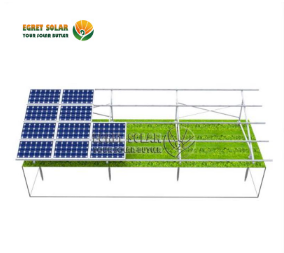
Why Do So Many Solar Projects Run Into Trouble Before Installation Even Begins?
I have seen buyers spend a lot of time focusing on panel efficiency while underestimating the practical challenges of site construction. On paper, ground-mounted solar looks straightforward. In reality, every site creates a different set of problems. Some locations have uneven ground. Some have soft soil or poor load-bearing conditions. Some need faster construction to meet project deadlines. Others are exposed to wind, rain, or corrosive environments that make material selection much more important than it first appears.
This is where the structure matters. A carefully planned Solar Ground Mounting System helps me think beyond the frame itself and toward the full project workflow. I want fewer surprises during installation, cleaner alignment in the field, better compatibility with foundation methods, and long-term confidence that the system will keep performing without becoming a maintenance burden.
- I look for a design that can adapt to different site conditions without overcomplicating installation.
- I want material options that fit both budget expectations and environmental demands.
- I value pre-assembled components because they can reduce on-site labor pressure.
- I pay attention to corrosion resistance because long service life is not negotiable in outdoor projects.
- I prefer systems that are easier for installers to handle consistently across large project areas.
What Should I Really Look For When Comparing a Solar Ground Mounting System?
When I compare suppliers, I try not to get distracted by vague promises. I focus on whether the system solves real project pain points. A good ground mounting solution should make engineering decisions simpler, not harder. It should also create a balance between structural strength, installation efficiency, material durability, and cost control.
| What I Evaluate | Why It Matters | What Stronger Solutions Usually Offer |
|---|---|---|
| Material selection | Directly affects strength, corrosion resistance, and cost | Flexible choice between aluminum and carbon steel based on project needs |
| Foundation compatibility | Different land conditions require different support methods | Adaptability for ground screws or concrete foundations |
| Installation efficiency | Labor time strongly affects total project cost | Pre-assembled parts and practical structural layout |
| Structural stability | Important for wind load, safety, and long-term performance | Reliable design with clear engineering logic |
| Maintenance burden | Impacts lifetime operating costs | Durable materials and cleaner, simpler system structure |
| Project scalability | Large projects need repeatable installation quality | Standardized components that support efficient expansion |
If I cannot clearly see how a supplier addresses these six areas, I know the buying decision is not ready yet. A Solar Ground Mounting System should not just look strong in a catalog. It has to work in procurement, logistics, installation, and long-term operation.
How Can Material Choice Change the Outcome of a Ground-Mounted Solar Project?
Material choice is one of the first practical decisions I make. Different projects do not need the exact same structure. In some situations, I may prioritize lighter weight and corrosion resistance. In others, I may focus more on cost-effectiveness and heavy-duty support. That is why I see real value in suppliers that can support both aluminum-based and carbon-steel-based ground mounting approaches.
Aluminum structures often appeal to me when I want a lighter solution with good corrosion performance and easier handling during installation. Carbon steel becomes attractive when I need a more cost-conscious structural option for larger-scale ground projects. The best part is not choosing one material forever. The best part is matching the right material to the right site, budget, and performance expectation.
That flexibility makes a Solar Ground Mounting System much more practical for distributors, EPC companies, and project developers who serve different markets. Instead of forcing every project into one design idea, the system can be adjusted around actual engineering needs.
| Material Option | Where I See It Working Well | Main Advantage | Main Consideration |
|---|---|---|---|
| Aluminum alloy | Projects requiring lighter handling and strong corrosion resistance | Lower weight and cleaner long-term outdoor performance | May need project-specific cost comparison |
| Carbon steel | Large ground projects focused on structural economy | Practical strength-to-cost balance | Surface treatment and environment suitability should be checked carefully |
Why Does Foundation Flexibility Matter More Than Many Buyers Realize?
One lesson I keep coming back to is that the site decides more than the product brochure does. Some ground conditions make screw pile foundations a better fit. Other sites are more suitable for concrete-based support. If a supplier cannot support this flexibility, then even a good-looking mounting system may become difficult to use in practice.
I like a Solar Ground Mounting System that does not trap me into a single foundation method. Foundation flexibility gives me more room to adapt the solution to terrain, soil, construction speed, and budget. It also makes the system more relevant across different countries and project categories, especially where land conditions vary sharply from one site to another.
- Ground screw solutions can support faster site execution in suitable soil conditions.
- Concrete foundations may be preferred where soil or structural requirements demand a different base strategy.
- Flexible design reduces the chance that a project needs to be redesigned late in the procurement cycle.
- Installers benefit when the system is engineered with realistic site application in mind.
From a buyer's perspective, this kind of adaptability is not a small feature. It can save time, reduce engineering friction, and improve confidence when managing multiple project sites.
Can Installation Speed Really Affect the Return on a Solar Project?
Absolutely, and I do not think this point gets enough attention. Every extra hour spent on manual alignment, field cutting, or repeated adjustment adds cost. When crews are working across a large area, even small inefficiencies multiply quickly. That is why I put serious value on pre-assembly and practical structural design.
If a Solar Ground Mounting System arrives with more of the work already thought through, installation becomes more controlled. Teams can spend less time correcting avoidable issues and more time completing the project. Faster execution does not just help contractors. It helps owners reach operational status sooner and start capturing energy output earlier.
| Installation Factor | Common Problem | Why Better Design Helps |
|---|---|---|
| Component preparation | Too many loose parts and confusing assembly flow | Pre-assembled components can simplify field work |
| Alignment consistency | Uneven installation across large sites | Structured system layout improves repeatability |
| Labor efficiency | High time cost during large-scale installation | Simpler assembly means crews can move more efficiently |
| Project schedule risk | Delays caused by overly complicated support systems | Practical design reduces avoidable hold-ups |
For me, the right mounting system is not only about what it does after installation. It is also about how much trouble it removes before the first panel is fully secured.
What Makes Long-Term Durability Such a Decisive Buying Factor?
Because ground-mounted solar is exposed every day. Sun, rain, wind, humidity, dust, and temperature swings all test the support structure year after year. If the mounting system ages badly, the project starts paying for that decision over and over. Maintenance becomes more frequent, inspection concerns increase, and the owner loses confidence in the asset.
That is why I pay close attention to corrosion resistance, manufacturing consistency, and service-life thinking. A dependable Solar Ground Mounting System should support stable outdoor use over the long term, not just survive the first installation season. Buyers who think in terms of total ownership cost usually understand this immediately. The cheapest visible option at purchase is not always the most economical choice over the life of the project.
In outdoor solar applications, durability is connected to almost everything else:
- It supports structural safety over time.
- It reduces the chance of premature replacement or repair.
- It helps owners manage long-term maintenance budgets more predictably.
- It protects the reputation of installers and project developers.
- It contributes to the steady operation expected from commercial and utility solar assets.
Why Do Buyers Need More Than Just a Low Price?
I understand why price gets attention. Every project has a budget. But when I evaluate suppliers, I do not treat low price as the finish line. I treat it as one part of a bigger calculation. If a lower-priced structure creates slower installation, more site rework, weaker durability, or limited adaptability, the savings may disappear very quickly.
What I really want is purchasing confidence. That means I want the supplier to support a balanced solution that makes sense in real use. A strong Solar Ground Mounting System should help me lower hidden costs, not just visible purchase cost.
| Buying Priority | What Happens With a Short-Term View | What Happens With a Long-Term View |
|---|---|---|
| Initial cost | Looks attractive at first glance | Gets weighed against installation and maintenance impact |
| Installation workload | Often underestimated | Recognized as a major cost driver |
| Material durability | Seen as secondary | Treated as central to lifecycle value |
| Site adaptability | Ignored until problems appear | Considered early to avoid redesign and delays |
| Operational stability | Assumed rather than evaluated | Built into the purchasing decision from the beginning |
Who Can Benefit Most From a Well-Planned Solar Ground Mounting System?
In my view, this type of system can serve a wide range of buyers because ground-mounted solar is relevant in many project environments. The key is matching the structure to the project's real demands.
- Project developers who need scalable and practical site solutions
- EPC contractors who care about installation efficiency and field execution
- Distributors who want a product line that can fit different customer needs
- Commercial and industrial users with available land and long-term energy goals
- Agricultural or open-area projects where rooftop installation is not the best option
- Utility-scale planners who need repeatable structural logic across larger sites
What these buyers have in common is simple. They do not only need a frame. They need a structure that supports the economics and reliability of the whole solar project.
How Do I Decide If This Is the Right Direction for My Next Solar Project?
I usually ask a few direct questions. Does the site have the space to benefit from ground mounting? Do I need flexibility in foundation choice? Am I trying to reduce labor pressure during installation? Do I need a material option that fits either corrosion resistance priorities or more cost-sensitive structural planning? Do I want a supplier that understands project practicality rather than just selling standard parts?
If the answer to several of those questions is yes, then a carefully selected Solar Ground Mounting System becomes a very strong option. And if I am looking for a supplier that can support different system directions with practical manufacturing experience, that is when Xiamen Egret Solar New Energy Technology Co., Ltd. becomes a name worth serious consideration.
The real value of a well-designed system is not hidden in marketing language. I see it in reduced installation friction, better structural planning, adaptable foundations, reliable materials, and stronger long-term project confidence. Those are the details that help solar projects move from idea to stable performance.
Why Wait to Improve Project Stability and Installation Efficiency?
If you are planning your next solar project and want a more dependable path from design to installation, this is the right time to look more closely at a proven Solar Ground Mounting System. Whether your priority is structural reliability, flexible foundation options, faster installation, or better long-term value, the right support solution can make a measurable difference. If you want tailored product guidance, practical recommendations, or a quotation based on your project conditions, contact us and leave your inquiry with Xiamen Egret Solar New Energy Technology Co., Ltd.. A better solar structure starts with a better conversation.