

What Makes Aluminum Solar Cabel PV1500DC-AL Practical for Modern PV Systems?
2026-09-30
As photovoltaic projects continue to expand from residential rooftops to commercial and utility-scale power plants, the selection of DC cables has become an important part of system design. A suitable cable must provide reliable electrical transmission while maintaining resistance to UV exposure, temperature changes, moisture, and outdoor operating conditions. Aluminum Solar Cabel PV1500DC-AL is designed for photovoltaic power generation applications and uses a tinned aluminum-alloy conductor, providing a practical alternative to conventional copper-based PV cables. Zhejiang Sowell Electric Co., Ltd. has developed a photovoltaic product portfolio covering solar cables, PV connectors, junction boxes, and related electrical accessories, with its solar-industry business dating back to 2006.
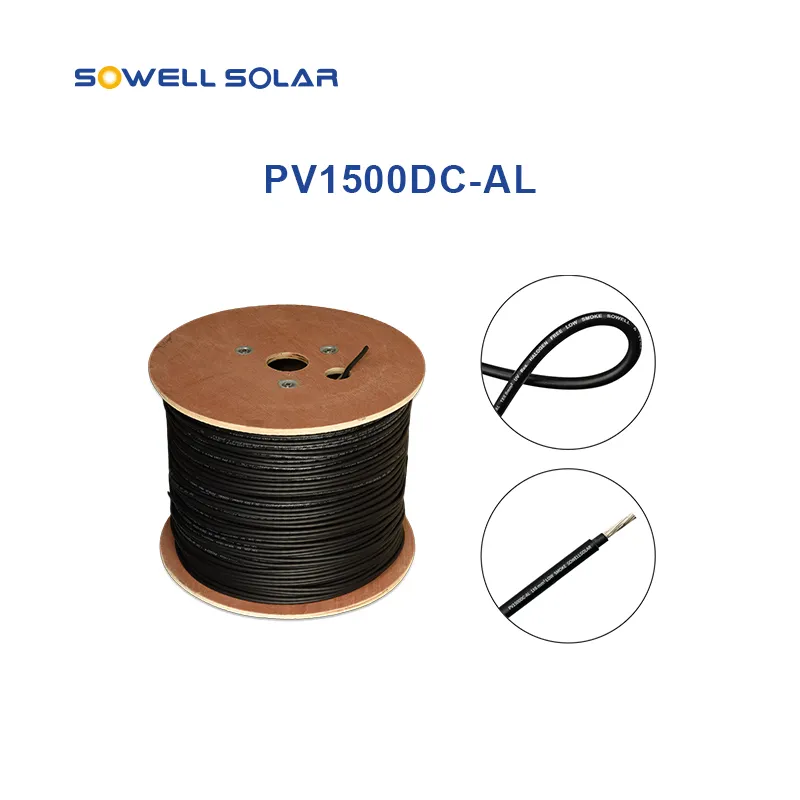
What Is Aluminum Solar Cabel PV1500DC-AL?
The Aluminum Solar Cabel PV1500DC-AL is a photovoltaic DC cable designed for solar power generation systems with a rated voltage of up to 1500V DC. According to the available product specification, its conductor is made from tinned aluminum alloy, while the insulation and sheath use 125°C XLPE materials.
This construction is intended to combine electrical performance with practical installation advantages. Aluminum-alloy conductors can reduce cable weight compared with equivalent copper constructions, which can be particularly useful when photovoltaic systems require long cable runs and extensive cable management.
For solar installers, EPC contractors, distributors, and system integrators, the value of this cable is not simply the conductor material. The complete cable structure, insulation, environmental resistance, voltage rating, compatibility, and manufacturing consistency all contribute to the reliability of a PV electrical system.
Key Product Characteristics
| Feature | PV1500DC-AL |
|---|---|
| Application | Photovoltaic power generation systems |
| Rated Voltage | DC 1500V |
| Conductor | Tinned aluminum alloy |
| Insulation | 125°C XLPE |
| Sheath | 125°C XLPE |
| Typical Environment | Outdoor PV applications |
| Main Advantage | Lightweight aluminum-alloy construction |
The product information published by Zhejiang Sowell Electric indicates that its PV cables are developed for photovoltaic applications and manufactured according to relevant international standards, including IEC and other PV cable standards depending on the product series.
Why Does Cable Selection Matter in Solar Projects?
A photovoltaic system may contain hundreds or thousands of meters of DC cabling. Every cable section contributes to the overall electrical connection between solar modules, junction boxes, combiner boxes, and inverters.
Poor cable selection can create several practical concerns:
- Increased electrical losses
- Difficult installation and cable management
- Greater mechanical stress during installation
- Faster degradation under unsuitable environmental conditions
- Additional maintenance requirements
- Potential compatibility problems with connectors and other components
Therefore, a professional PV cable should be selected according to the system voltage, current, conductor cross-section, installation environment, connector requirements, and applicable standards.
For large commercial or utility-scale installations, these factors become even more significant because cable routes can be long and installation efficiency directly affects project labor and construction management.
How Does the Aluminum Alloy Construction Improve Installation?
One of the notable characteristics of Aluminum Solar Cabel PV1500DC-AL is its aluminum-alloy conductor. Compared with conventional copper cable constructions, aluminum-based conductors can offer a lower-weight solution.
This can make handling, routing, and installation more convenient, especially when installers need to manage long cable sections across rooftops, solar fields, or equipment areas.
Practical Installation Benefits
1. Easier Handling
A lighter cable can be easier for workers to transport and position during installation.
2. More Convenient Cable Routing
When a PV project contains long DC cable routes, reducing cable weight can simplify transportation and cable-management work.
3. Suitable for Large PV Installations
Utility-scale and commercial photovoltaic projects often involve extensive DC wiring. Aluminum-alloy cable can provide another option for project designers looking to balance electrical requirements and installation considerations.
4. Outdoor-Oriented Construction
The specification of PV1500DC-AL identifies XLPE insulation and sheath materials, while PV cable constructions in this product family are designed for photovoltaic environments.
Where Is PV1500DC-AL Used?
The primary role of Aluminum Solar Cabel PV1500DC-AL is to transmit DC electrical power within photovoltaic systems.
Typical application scenarios include:
- Solar power plants
- Commercial rooftop PV systems
- Industrial rooftop solar projects
- Utility-scale photovoltaic installations
- Solar module wiring systems
- Connections between PV equipment and DC components
- PV combiner box and inverter connection applications
A PV cable should always be matched with the electrical specifications and installation requirements of the complete system rather than selected only according to conductor material.
Aluminum vs. Copper: What Should Buyers Consider?
Aluminum and copper both have established applications in electrical systems. For photovoltaic projects, the appropriate choice depends on the system design, required cross-section, current capacity, installation conditions, connector technology, and project budget.
| Consideration | Aluminum-Alloy PV Cable | Copper PV Cable |
|---|---|---|
| Conductor Material | Aluminum alloy | Copper |
| Weight | Generally lighter | Generally heavier |
| Handling | Convenient for long cable routes | More weight to manage |
| Electrical Conductivity | Lower than copper | Higher |
| Installation Planning | Requires suitable terminals/connectors | Widely familiar |
| PV Application | Suitable when system specifications are matched | Widely used |
The comparison does not mean one material is universally preferable. Instead, project engineers should select the conductor according to electrical calculations, applicable standards, connector compatibility, installation conditions, and total project requirements.
What Makes Zhejiang Sowell Electric a PV Cable Supplier?
Zhejiang Sowell Electric Co., Ltd. focuses on the R&D, sales, and technical services of photovoltaic products. Its product range includes photovoltaic cables, solar DC cables, PV connectors, junction boxes, and related electrical accessories. The company states that it entered the solar industry in 2006 and operates manufacturing facilities in China.
Its product portfolio includes different PV cable constructions, such as tinned copper cables, copper-alloy cables, aluminum-alloy cables, and higher-voltage solar cable solutions. This broader product range allows buyers to evaluate cable options according to different photovoltaic system requirements.
The company also states that its production system includes multiple production lines with substantial daily solar cable capacity, supporting requirements from international PV customers.
How Can Buyers Select the Right PV Cable?
Before ordering Aluminum Solar Cabel PV1500DC-AL, buyers should review several technical and commercial factors:
- System voltage – Confirm that the cable rating matches the PV system.
- Current requirement – Select an appropriate conductor size according to the design current.
- Cable length – Consider voltage drop and overall DC circuit design.
- Installation environment – Evaluate UV exposure, temperature, moisture, and mechanical conditions.
- Connector compatibility – Ensure that the cable and connector combination is technically suitable.
- Certification requirements – Confirm the standards and certificates required in the target market.
- Project quantity – Large projects may require customized packaging, reels, delivery schedules, or production planning.
These points can help EPC contractors, solar distributors, and project purchasers reduce unnecessary procurement risks.
The Role of Reliable PV Cables in Long-Term Solar Performance
Solar panels generate electricity, but cables are responsible for transporting that electricity through the system. Consequently, the cable is an essential part of the balance-of-system infrastructure.
A properly selected PV cable can contribute to stable power transmission, easier installation, appropriate environmental protection, and better overall system maintainability. For projects expected to operate outdoors for many years, cable construction and material selection should therefore receive the same careful attention as other electrical components.
For buyers seeking a 1500V aluminum-alloy photovoltaic cable, PV1500DC-AL provides a specialized option for PV applications. Zhejiang Sowell Electric Co., Ltd. combines this product with a broader portfolio of solar cables and PV accessories, supporting customers that need coordinated photovoltaic electrical solutions.
Build a More Practical PV Cabling Solution
The right solar cable should do more than carry electrical current. It should fit the project's voltage requirements, installation conditions, connector system, environmental demands, and procurement schedule.
With its tinned aluminum-alloy conductor, 1500V DC rating, and PV-oriented cable construction, Aluminum Solar Cabel PV1500DC-AL offers a practical solution for photovoltaic applications where weight, installation efficiency, and system requirements need to be considered together.
For solar distributors, EPC contractors, installers, and photovoltaic project developers looking for reliable cable solutions, Zhejiang Sowell Electric Co., Ltd. can provide product information and technical support for different PV applications. Contact us to discuss your project requirements, cable specifications, samples, and customized procurement needs.