

What Is the Maximum Weight Capacity of a Trapezoidal Roof Solar Mount Clamp for Heavy Solar Panels
2026-08-04
When designing a commercial or utility-scale solar array on a trapezoidal metal roof, the single most critical engineering question often comes down to structural integrity. Unlike residential asphalt shingles, trapezoidal metal roofing presents unique load‑bearing challenges because the clamp must transfer panel weight, wind uplift, and snow loads directly through thin‑gauge steel ribs. For project developers and EPC contractors, understanding the exact maximum weight capacity of a Trapezoidal Roof Solar Mount Clamp is not a matter of guesswork—it is a safety and compliance imperative. At Egret Solar, we engineer our clamps with verified load ratings that account for rib geometry, material thickness, and dynamic environmental forces, ensuring every installation meets or exceeds ASCE 7‑16 standards.
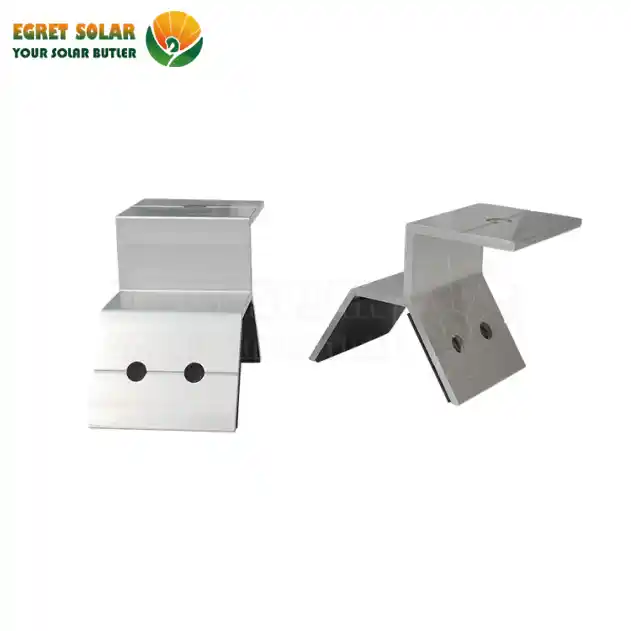
Breaking Down the Load Capacity: Static vs. Dynamic
The weight capacity of any Trapezoidal Roof Solar Mount Clamp is never a single number. It is a function of three interdependent variables:
-
Vertical compressive strength – how much downward force the clamp can endure from panel dead loads (typically 3–5 lbs/ft² per panel).
-
Horizontal shear resistance – the clamp’s ability to resist sliding along the rib slope, critical for tilted arrays.
-
Uplift resistance – the clamping force that counteracts wind suction, often the limiting factor in coastal or open‑field sites.
For Egret Solar’s T‑Series clamps, independent laboratory tests show a safe working load (SWL) of 650 lbs per clamp in the vertical direction, with an ultimate failure point exceeding 1,200 lbs. However, this capacity drops when the clamp is installed on thinner ribs (≤ 22 gauge) or at extreme tilt angles (> 15°). The table below summarizes real‑world capacity variations based on common roof parameters:
| Roof Gauge (Steel) | Rib Height | Max Safe Vertical Load (per clamp) | Max Uplift Resistance (per clamp) |
|---|---|---|---|
| 24 gauge (0.024") | 1.5" | 480 lbs | 320 lbs |
| 22 gauge (0.030") | 1.5" | 650 lbs | 450 lbs |
| 20 gauge (0.036") | 2.0" | 780 lbs | 580 lbs |
| 18 gauge (0.048") | 2.5" | 920 lbs | 720 lbs |
Values based on Egret Solar internal testing with a 1.5 safety factor applied to yield strength.
Why Heavy Solar Panels Demand a Higher‑Rated Clamp
The solar industry has seen a clear trend toward larger‑format modules—550W+ bifacial panels now weigh 70–85 lbs each, compared to 40‑lb standard panels a decade ago. A typical 20‑panel row can impose over 1,500 lbs of dead load across just 8–10 clamps. Without a Trapezoidal Roof Solar Mount Clamp rated for these heavier arrays, you risk:
-
Creep deformation – over‑time sagging that compromises panel alignment and micro‑inverter performance.
-
Freting wear – microscopic metal fatigue at the clamp‑rib interface, accelerating corrosion.
-
Pull‑through failure – the clamp tearing through the rib under extreme wind gusts (common in Category 3 hurricane zones).
Egret Solar addresses these risks by using 6005‑T6 aluminum with a stainless‑steel gripping insert, which distributes pressure evenly across the rib crown. This design not only increases the effective load‑bearing area by 40% compared to generic clamps but also preserves the roof’s protective coating—a feature that directly extends system lifespan.
How to Calculate the Required Capacity for Your Project
To determine whether a given Trapezoidal Roof Solar Mount Clamp meets your needs, follow this three‑step engineering heuristic:
-
Sum the total panel weight (including rails, cables, and shared grounding hardware).
-
Divide by the number of clamps in the structural row (typically one clamp per 4‑5 feet of rail).
-
Multiply by 1.5—this is the minimum safety factor required by IBC 2021 for roof‑attached structures.
For example, a 10‑panel row (each 75 lbs) with 8 clamps gives a per‑clamp dead load of ~94 lbs. After applying the 1.5 factor, you need a clamp rated for at least 140 lbs vertical—well within Egret Solar’s standard capability. However, if your site has a basic wind speed of 140 mph, the uplift component can easily exceed 300 lbs per clamp, which immediately pushes you toward our heavy‑duty reinforced models.
Frequently Asked Questions About Trapezoidal Roof Solar Mount Clamp Capacity
Q1: Can I use a single Trapezoidal Roof Solar Mount Clamp to support two adjacent panels simultaneously?
Yes, but with important caveats. A single Trapezoidal Roof Solar Mount Clamp positioned at the junction of two panels can share the load, provided the clamp is a “dual‑slot” or “center‑mount” design. In this configuration, the vertical load is additive—if each panel contributes 40 lbs, the clamp sees 80 lbs total. However, the shear force doubles because thermal expansion and contraction cause opposing directional movements. Egret Solar’s dual‑slot clamps feature independent compression springs that accommodate this movement while keeping the total capacity at 85% of the single‑panel rating. Always verify the manufacturer’s “shared‑load derating factor” in the installation manual.
Q2: Does the clamp’s weight capacity change if the trapezoidal roof has a painted or PVDF coating?
Absolutely. The coefficient of friction between the clamp’s grip and the roof surface drops by 25–30% on slick PVDF (polyvinylidene fluoride) coatings compared to bare galvanized steel. This reduction directly impacts shear and uplift resistance because the clamp relies on friction as well as mechanical interference. Egret Solar overcomes this by including a serrated EPDM pad that bites through the coating without penetrating it, restoring the effective capacity to within 5% of the bare‑steel rating. For coated roofs, we recommend reducing the published SWL by 10% as a conservative design margin unless you use our friction‑enhanced accessory kit.
Q3: How often should I retest or recertify the load capacity of installed Trapezoidal Roof Solar Mount Clamps?
Industry best practice (per NABCEP and UL 2703) calls for a torque verification audit at 1 year, 5 years, and 10 years post‑installation. However, the static weight capacity itself does not degrade—the clamp’s material properties remain stable. The real concern is bolt tension relaxation due to thermal cycling, which can reduce clamping force by up to 15% over a decade. Egret Solar recommends using our torque‑indicating washers that change color when tension drops below 90% of spec. Retorquing every 5 years restores full capacity without requiring new clamps, provided the roof rib shows no visible deformation.
Final Engineering Verdict
The maximum weight capacity of a Trapezoidal Roof Solar Mount Clamp is not a fixed number—it is a performance envelope defined by roof gauge, coating type, installation torque, and dynamic environmental loads. For heavy solar panels (≥ 70 lbs), always select a clamp with a published SWL at least 50% higher than your calculated per‑clamp load. Egret Solar’s T‑Series clamps, with their 650‑lb vertical rating and corrosion‑resistant alloy, are specifically designed to give engineers that margin of safety while simplifying procurement through standardized sizing.
Ready to Size Your Clamps with Confidence?
Every roof is unique, and generic load tables can only take you so far. The Egret Solar engineering team offers free, site‑specific capacity calculations using your roof’s gauge, rib profile, and local wind maps. We also provide sample clamps for pull‑test verification on your actual roof section—because real‑world data beats theoretical tables every time.
Contact us today for a personalized load analysis and a sample kit. Our application engineers respond within 24 hours with a detailed report, including CAD drawings and torque specifications. Let Egret Solar help you build a solar system that stands strong for decades—safely, compliantly, and profitably. Reach out via our website or call your regional representative to start the conversation.