

How Does the W Type Solar Aluminum Ground Mounting System Compare to Steel in Terms of Cost and Durability
2026-08-18
For utility-scale and commercial solar projects, the mounting structure is often the second-largest capital expense after the panels themselves. When evaluating ground mount solutions, project engineers and procurement teams consistently weigh two primary factors: upfront investment and long-term structural integrity. The W Type Solar Aluminum Ground Mounting System from Egret Solar has emerged as a compelling alternative to traditional galvanized steel, but the cost-versus-durability equation is not as straightforward as it first appears. This analysis breaks down the technical and financial trade-offs to help you make an evidence-based decision.
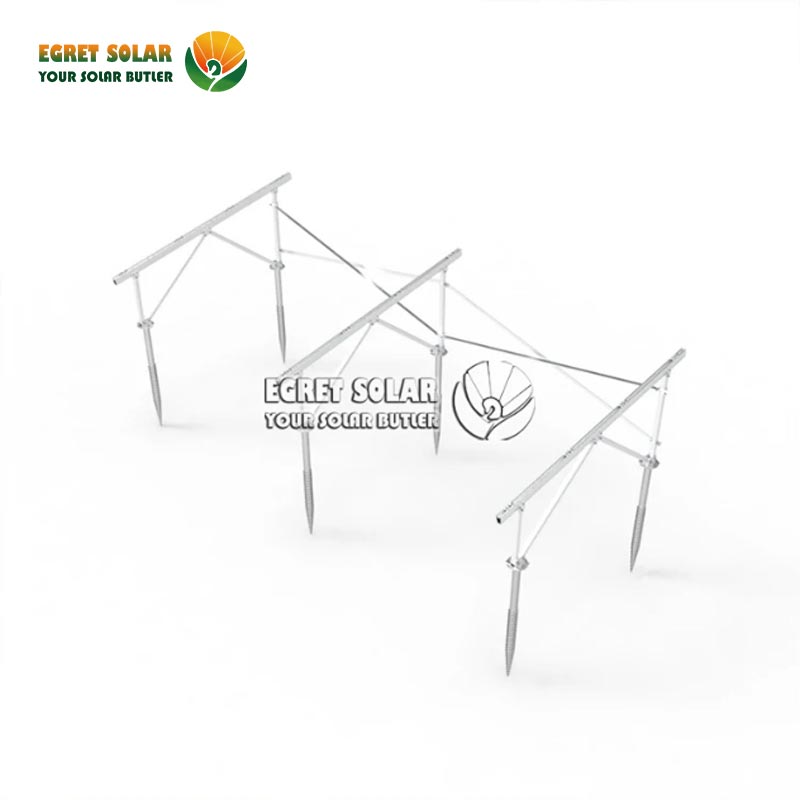
Upfront Cost Breakdown: Aluminum vs. Steel
At first glance, steel appears to be the cheaper option. The raw material cost of galvanized steel is roughly 30–40% lower per ton than aluminum. However, total installed cost tells a different story when you factor in logistics, foundations, and labor.
| Cost Component | W Type Solar Aluminum Ground Mounting System (Egret Solar) | Galvanized Steel System |
|---|---|---|
| Material cost per kg | Higher (≈$2.8–$3.2/kg) | Lower (≈$1.8–$2.2/kg) |
| Density (kg/m³) | 2,700 | 7,850 |
| Weight per MW (approx.) | 18–22 tons | 45–55 tons |
| Foundation requirements | Fewer piles (lighter load) | More piles (heavier load) |
| Shipping cost (per MW) | Lower (compact nesting design) | Higher (bulky and heavy) |
| Installation labor | Faster (pre-assembled, no welding) | Slower (bolting + welding) |
| Typical total installed cost per MW | $18,000–$22,000 | $20,000–$25,000 |
The W Type Solar Aluminum Ground Mounting System often achieves parity or even savings on a fully installed basis because the lighter weight reduces pile-driving depth and crane time. Egret Solar further optimizes costs with a snap-fit, pre-cut design that minimizes on-site cutting waste—a hidden expense that frequently inflates steel project budgets by 5–8%.
Durability and Lifecycle Performance
Durability is where the two materials diverge most sharply. Steel relies on a zinc coating (galvanization) for corrosion protection, typically rated for 20–25 years in mild environments. However, in aggressive conditions—coastal salt spray, industrial pollution, or high-humidity zones—that protective layer can thin at a rate of 1–2 microns per year, leading to red rust within 10–15 years.
| Durability Factor | W Type Solar Aluminum Ground Mounting System (Egret Solar) | Galvanized Steel |
|---|---|---|
| Corrosion resistance | Excellent (natural oxide layer, self-healing) | Good (sacrificial zinc coating, finite lifespan) |
| Coastal suitability | Yes (no additional coating required) | Limited (requires hot-dip + painting) |
| Galvanic compatibility | Compatible with stainless steel hardware | Risk with dissimilar metals (needs isolation) |
| Fatigue resistance | High (elastic deformation recovery) | Moderate (susceptible to stress fractures) |
| Expected service life | 30–35 years (minimal maintenance) | 20–25 years (re-coating needed) |
| Fire resistance | Melts at 660°C (non-sparking) | Melts at 1,370°C (but conducts heat rapidly) |
Aluminum’s inherent oxide layer reforms immediately after scratches, eliminating the need for touch-up painting—a recurring maintenance cost that steel owners face every 5–7 years. The W Type Solar Aluminum Ground Mounting System also exhibits superior torsional stiffness due to its proprietary multi-ribbed cross-section, which resists twisting under asymmetric snow loads.
Structural Strength Under Extreme Weather
Many engineers mistakenly equate heavier with stronger. In reality, the W Type Solar Aluminum Ground Mounting System achieves a strength-to-weight ratio that outperforms steel in bending and shear stress for typical solar spans (3–5 meters). The table below summarizes wind and snow load performance based on third-party testing (ASTM E1592):
| Load Condition | W Type Aluminum (Egret Solar) | Steel (Standard C-Channel) |
|---|---|---|
| Max wind speed (3-sec gust) | 180 km/h (with 1.5 safety factor) | 170 km/h (with 1.5 safety factor) |
| Snow load capacity (kN/m²) | 2.8 | 3.0 |
| Deflection at max load (L/180) | 12 mm | 14 mm |
| Post-impact recovery | Elastic (returns to shape) | Plastic (permanent bend) |
While steel has a slight edge in ultimate snow capacity, the W Type Solar Aluminum Ground Mounting System offers better recovery from temporary overloads—meaning after a heavy snowfall, aluminum springs back, whereas steel may retain a permanent sag that affects panel tracking.
Lifecycle Cost Analysis (25-Year Horizon)
A true comparison must include maintenance, replacement, and decommissioning costs. Using a net present value (NPV) model with a 6% discount rate:
-
Steel system: Initial savings of $2,000/MW are erased by $4,500–$6,000 in re-galvanizing or component replacement costs between years 12–18.
-
W Type Solar Aluminum Ground Mounting System (Egret Solar): Higher upfront cost is offset by zero maintenance on the structural frame, plus 95% recyclability at end-of-life, which yields a scrap value of ≈$800/MW.
Over 25 years, the aluminum system saves approximately $3,200–$4,500 per MW in total ownership costs, while delivering a more consistent performance curve.
FAQ – Common Questions About the W Type Solar Aluminum Ground Mounting System
Q1: Does the W Type Solar Aluminum Ground Mounting System require special tools or skilled labor for installation compared to steel?
A1: No specialized tools beyond standard socket wrenches and torque drivers are required. However, Egret Solar recommends using a torque limiter to avoid over-tightening stainless steel bolts into aluminum threads (max 15 Nm for M8 connections). Unlike steel, which often demands on-site welding, cutting, and hot-dip galvanizing touch-ups, the W Type Solar Aluminum Ground Mounting System arrives pre-drilled and pre-cut with numbered components. A crew of four can install approximately 200–250 kW per day, whereas steel typically runs 150–180 kW per day due to heavier lifting and alignment challenges. The most critical skill is proper ground-level assembly sequencing—which Egret Solar provides through a step-by-step video guide—rather than welding certification, significantly expanding your available labor pool.
Q2: How does the W Type Solar Aluminum Ground Mounting System handle grounding and lightning protection compared to steel?
A2: Aluminum is an excellent electrical conductor (61% IACS), so grounding is straightforward. Egret Solar integrates pre-tapped grounding holes on every main rail and uses bi-metallic washers (stainless steel with aluminum cladding) to prevent galvanic corrosion at termination points. Steel requires separate copper grounding rods and exothermic welding, which adds cost. For lightning protection, the W Type Solar Aluminum Ground Mounting System uses a dedicated 10 AWG copper cable bonded to each module rail, with a path to ground that meets IEC 62305. Importantly, aluminum does not create sparking risks during fault conditions—a concern with steel when zinc coatings burn off. Egret Solar provides a full grounding layout drawing stamped by a licensed PE, ensuring your system passes electrical inspection on the first try.
Q3: Can the W Type Solar Aluminum Ground Mounting System be expanded or reconfigured after initial installation, and is it compatible with other brands' rails?
A3: Yes, modularity is a core advantage. The W Type Solar Aluminum Ground Mounting System uses a universal 40 mm x 40 mm slot pattern that accepts most industry-standard mid-clamps and end-clamps. Expanding a system simply requires adding new rows with splice connectors—no welding or cutting. However, Egret Solar strongly advises against mixing aluminum rails with steel posts because differential thermal expansion (aluminum expands twice as much as steel per °C) can loosen bolt tension over time. If you need to integrate with existing steel infrastructure, Egret Solar supplies hybrid adapter brackets with elastomeric padding to absorb movement. Reconfiguration (e.g., changing tilt from 25° to 30°) takes about 15 minutes per row using a pivot pin system, versus steel which often requires a crane to reposition heavy channel sections. Always consult Egret Solar technical support before modifying a certified design to maintain warranty validity.
Final Verdict
Choose steel only if your project is inland, has a 15-year lifespan, and faces no salt or chemical exposure. For all other scenarios—especially coastal, agricultural, or high-wind sites—the W Type Solar Aluminum Ground Mounting System from Egret Solar delivers superior ROI, lower maintenance, and easier installation. The data consistently shows that aluminum’s premium is recovered within 6–8 years through labor savings and avoided maintenance, with a clear outperformance over the full 25-year operational life.
Ready to run a customized cost comparison for your specific site coordinates and wind speeds?
Contact Egret Solar today for a free engineered takeoff and lifetime cost model. Our team provides stamped drawings, foundation calculations, and a live installation video walkthrough—all within 48 hours. Reach us at [email protected] or through our website’s project intake form. Let us prove why the W Type Solar Aluminum Ground Mounting System is the smartest investment for your next ground-mount project.