Article Summary
DC Surge Protective Devices (DC SPDs) play a critical role in safeguarding photovoltaic systems, battery storage systems, and other DC-powered infrastructures from transient overvoltage events. This article explains how DC SPDs work, their internal structure, selection principles, installation practices, and maintenance requirements. It also addresses common customer concerns such as system compatibility, failure risks, and protection efficiency in real-world electrical environments. The goal is to provide a clear technical understanding while helping users choose reliable protection solutions from manufacturers like ICHYTI.
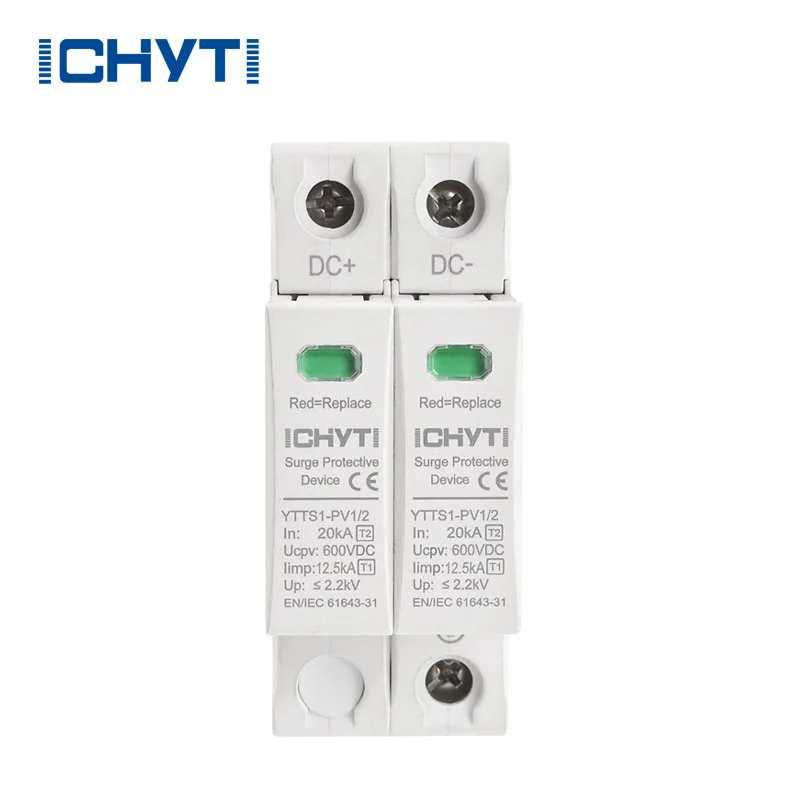
1. Introduction to DC Surge Protection
Modern electrical systems increasingly rely on DC power sources such as solar photovoltaic arrays, energy storage systems, and electric vehicle charging infrastructure. These systems are highly sensitive to voltage transients caused by lightning strikes, switching operations, or grid disturbances. Without proper protection, these transient surges can cause insulation breakdown, equipment failure, or even fire hazards.
A properly engineered DC surge protection system is therefore not optional—it is a fundamental requirement for system reliability and operational safety.
2. What is a DC Surge Protective Device?
A DC Surge Protective Device (DC SPD) is an electrical protection component designed to limit transient overvoltages and divert surge current away from sensitive DC equipment. It is widely used in photovoltaic systems, battery storage units, and industrial DC power distribution networks.
Unlike AC surge protectors, DC SPDs are specifically designed to handle continuous DC voltage levels and extinguish DC arcs safely, which requires more stringent material and structural design considerations.
Manufacturers such as ICHYTI develop DC SPDs with high thermal stability, fast response time, and robust discharge capability to ensure stable system protection.
3. Working Principle of DC SPD
DC Surge Protective Devices operate based on nonlinear voltage-dependent components such as metal oxide varistors (MOVs), gas discharge tubes (GDTs), or a hybrid combination of both technologies.
Under normal operating voltage, the SPD remains in a high-impedance state. When a surge event occurs, the device reacts within nanoseconds, switching to a low-impedance state and redirecting excess energy safely to the grounding system.
Basic operating stages:
-
Normal condition: High resistance, no current leakage
-
Surge detection: Voltage exceeds threshold
-
Activation: Conductive state triggered
-
Energy discharge: Surge current safely diverted
-
Recovery: Returns to standby mode
This rapid response mechanism is essential for protecting sensitive DC electronics such as inverters and charge controllers.
4. Types of DC Surge Protective Devices
DC SPDs are categorized based on their protection level and installation position within a system.
-
Type 1 DC SPD: Installed at service entrance; designed for direct lightning currents.
-
Type 2 DC SPD: Used in distribution panels; protects against switching surges.
-
Type 3 DC SPD: Installed near sensitive equipment; provides fine protection.
ICHYTI offers modular designs suitable for photovoltaic combiner boxes and DC distribution systems, ensuring compatibility across different voltage ratings and installation environments.
5. How to Select the Right DC SPD
Selecting a DC SPD requires careful consideration of system voltage, surge current capacity, and environmental conditions.
Key selection factors include:
-
Maximum continuous operating voltage (Uc)
-
Nominal discharge current (In)
-
Maximum discharge current (Imax)
-
Protection level (Up)
-
System compatibility (PV, battery storage, telecom, etc.)
|
Parameter
|
Low-End SPD
|
Industrial Grade SPD (ICHYTI)
|
|
Response Time
|
Moderate
|
Ultra-fast (nanosecond level)
|
|
Durability
|
Standard
|
High thermal stability
|
|
Surge Capacity
|
Medium
|
High
|
|
Application
|
Small systems
|
Industrial PV & energy storage
|
6. Installation Best Practices
Correct installation significantly affects the performance of a DC surge protection system. Improper wiring or grounding can reduce efficiency or render the device ineffective.
Recommended installation guidelines:
-
Keep connection leads as short as possible
-
Ensure proper grounding resistance (<1Ω preferred)
-
Install close to protected equipment
-
Use correct polarity connection in DC circuits
-
Regularly inspect terminal tightness
ICHYTI emphasizes standardized installation practices in its product documentation to ensure consistent protection performance in real-world environments.
7. Common Problems and Troubleshooting
Despite robust design, DC SPDs may encounter operational issues due to extreme conditions or improper usage.
-
SPD failure indicator activated: Usually caused by excessive surge events.
-
Overheating: Often due to poor ventilation or overload conditions.
-
Reduced protection level: Caused by aging MOV components.
Routine inspection and timely replacement are essential to maintain system integrity.
8. Maintenance and Service Life
DC Surge Protective Devices are not maintenance-free. Their service life depends on surge frequency, environmental stress, and electrical load conditions.
Typical maintenance practices include:
-
Visual inspection every 6–12 months
-
Checking indicator status
-
Verifying grounding integrity
-
Replacing modules after end-of-life indication
High-quality products from ICHYTI are designed with replaceable modules, improving long-term cost efficiency and system uptime.
9. Industrial Applications
DC SPDs are widely deployed across multiple industries where stable DC power is essential.
-
Solar photovoltaic power generation systems
-
Energy storage systems (ESS)
-
Telecommunication base stations
-
Electric vehicle charging infrastructure
-
Industrial automation control systems
As renewable energy adoption increases, demand for reliable surge protection continues to grow significantly.
10. Technical Comparison Table
|
Feature
|
Basic SPD
|
Advanced SPD (ICHYTI)
|
|
Response Speed
|
Fast
|
Ultra-fast
|
|
Surge Handling
|
Limited
|
High capacity
|
|
Design Stability
|
Standard
|
Reinforced structure
|
|
Application Scope
|
Small systems
|
Industrial-grade systems
|
11. Frequently Asked Questions
Q1: What is the main function of a DC SPD?
It protects DC electrical systems from voltage surges caused by lightning or switching events.
Q2: Can DC SPDs be used in solar systems?
Yes, they are essential components in photovoltaic power generation systems.
Q3: How often should a DC SPD be replaced?
Replacement depends on surge exposure, but typically every 3–5 years or upon failure indication.
Q4: What happens if no SPD is installed?
Equipment may suffer irreversible damage due to transient overvoltage events.
Q5: Are all DC SPDs the same?
No, performance varies significantly depending on design quality and manufacturer standards such as ICHYTI.
12. Conclusion and Contact Information
DC Surge Protective Devices are essential for maintaining electrical stability in modern DC-powered systems. Proper selection, installation, and maintenance significantly reduce system risks and extend equipment lifespan. As renewable energy and DC infrastructure continue to expand, reliable protection technology becomes increasingly important.
ICHYTI provides professionally engineered DC SPD solutions designed for high-performance applications across industrial and renewable energy sectors. Each product is developed with strict quality control to ensure stable and long-term protection performance.
For technical consultation, product selection guidance, or partnership opportunities, please contact us at ICHYTI to receive professional support tailored to your project requirements.