

How Does Ballasted PV Mounting System Work?
2026-05-18
Abstract
A Ballasted PV Mounting System is a non-penetrating solar panel installation solution widely used on flat rooftops where roof integrity must be preserved. Instead of anchoring into the roof structure, it relies on weighted blocks (ballast) to secure photovoltaic modules against wind uplift and environmental loads. This article explains how the system works, its structural principles, key components, installation process, advantages, limitations, and practical applications. It is designed to help project developers, EPC contractors, and facility owners make informed engineering and procurement decisions when deploying solar energy systems on commercial and industrial rooftops.
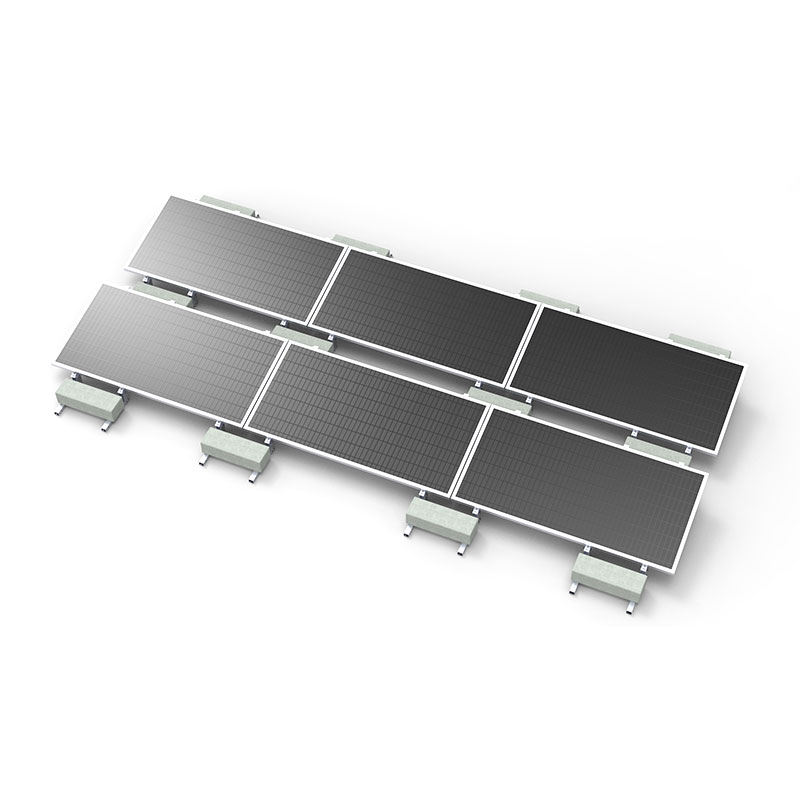
Table of Contents
- 1. Overview of Ballasted PV Mounting System
- 2. Core Components and Structural Logic
- 3. How the System Works
- 4. Key Advantages
- 5. Engineering and Design Considerations
- 6. Installation Process
- 7. Ballasted vs Penetrating Systems
- 8. Typical Applications
- 9. Challenges and Engineering Solutions
- 10. Frequently Asked Questions
1. Overview of Ballasted PV Mounting System
A Ballasted PV Mounting System is a rooftop solar support structure designed for flat or low-slope roofs where drilling or roof penetration is undesirable. It uses weighted concrete blocks or similar dense materials to stabilize photovoltaic arrays. The system distributes mechanical loads evenly across the roof surface, minimizing stress concentration and protecting waterproofing layers.
This approach is particularly suitable for commercial warehouses, logistics centers, manufacturing facilities, and public buildings where roof warranty protection is critical. Companies such as Xiamen CYC Energy specialize in providing engineered ballasted mounting solutions tailored to different wind zones and structural requirements.
2. Core Components and Structural Logic
The system is composed of several engineered components that work together to ensure stability, durability, and long-term performance.
- Ballast Blocks: Concrete or composite weights that resist uplift forces.
- Mounting Rails: Aluminum or galvanized steel profiles supporting PV modules.
- Module Clamps: Fixing elements securing panels to rails.
- Wind Deflectors: Aerodynamic structures reducing uplift pressure.
- Rubber Pads: Protective layers preventing roof membrane damage.
Structurally, the system operates on a balance of gravitational force (ballast weight) versus wind uplift force acting on the photovoltaic array.
3. How the System Works
The working principle of a Ballasted PV Mounting System is based on mechanical equilibrium. When wind flows over a rooftop solar array, it generates uplift pressure. Instead of anchoring the structure into the roof, the system counters this force using calculated ballast weight.
The design process involves:
- Wind load analysis based on local building codes
- Determination of uplift forces on PV modules
- Calculation of required ballast per square meter
- Optimization of layout to minimize roof loading
Once installed, the system remains stable through friction, weight distribution, and aerodynamic optimization.
4. Key Advantages
Ballasted PV mounting systems offer several engineering and commercial advantages:
- No roof penetration: Preserves waterproofing integrity.
- Faster installation: Reduces labor and mechanical anchoring time.
- Flexible layout: Adaptable to roof obstacles and irregular shapes.
- Lower maintenance risk: Minimizes leak-related roof damage.
- Scalability: Suitable for both small and large commercial systems.
5. Engineering and Design Considerations
Proper design is essential for safe and efficient system performance. Engineers must consider multiple structural and environmental factors:
| Design Factor | Description |
|---|---|
| Wind Load Zone | Determines uplift pressure and ballast requirements |
| Roof Load Capacity | Ensures structural safety under added weight |
| Friction Coefficient | Affects system stability on roof surface |
| Drainage Path | Prevents water accumulation under modules |
| Thermal Expansion | Accounts for material movement over time |
Advanced engineering tools are often used by providers like Xiamen CYC Energy to simulate real-world load conditions before deployment.
6. Installation Process
Installation of a ballasted system follows a streamlined mechanical process:
- Roof inspection and structural verification
- Layout marking based on design drawings
- Placement of protective rubber pads
- Positioning of mounting bases and rails
- Installation of PV modules
- Placement of ballast blocks
- Final torque check and system inspection
Because no drilling is required, installation time is significantly reduced compared to traditional fixed-anchoring systems.
7. Ballasted vs Penetrating Systems
| Feature | Ballasted System | Penetrating System |
|---|---|---|
| Roof Impact | No penetration | Requires drilling |
| Installation Speed | Fast | Moderate |
| Waterproof Risk | Very low | Higher if poorly sealed |
| Structural Load | Higher distributed load | Point load at anchors |
| Best Use Case | Flat commercial roofs | Pitched roofs or high-wind anchoring |
8. Typical Applications
Ballasted PV mounting systems are widely used in:
- Industrial warehouses
- Shopping malls
- Cold storage facilities
- Logistics distribution centers
- Institutional buildings
Their adaptability makes them a preferred solution in urban solar deployment where roof preservation is essential.
9. Challenges and Engineering Solutions
Despite their advantages, ballasted systems present engineering challenges:
- High roof load: Requires structural assessment before installation.
- Wind uplift risk: Must be mitigated with precise ballast calculation.
- Space efficiency: Ballast may reduce usable rooftop area.
To address these issues, modern systems integrate aerodynamic frames, optimized tilt angles, and lightweight composite materials. Engineering teams at Xiamen CYC Energy continuously refine designs to improve load efficiency and wind resistance performance.
10. Frequently Asked Questions
Q1: Is a ballasted PV mounting system safe for all roofs?
No. Roof structural capacity must be evaluated before installation to ensure it can support additional load.
Q2: Can it withstand strong winds?
Yes, if properly engineered with correct ballast calculations based on local wind load standards.
Q3: Does it damage waterproofing layers?
No direct penetration is required, and protective pads are used to avoid membrane damage.
Q4: How long does installation take?
Typically shorter than penetrating systems due to simplified mechanical assembly.
Q5: What is the lifespan of the system?
With proper materials and maintenance, it can exceed 25 years, matching PV module lifespan.
Conclusion
A Ballasted PV Mounting System provides a structurally efficient and roof-friendly method for deploying solar energy systems on flat rooftops. By using calculated ballast instead of mechanical anchoring, it preserves roof integrity while maintaining strong resistance to wind loads and environmental stress. Its engineering flexibility, ease of installation, and compatibility with commercial rooftops make it a preferred solution in modern solar infrastructure development.
Xiamen CYC Energy delivers engineered mounting systems designed to meet diverse project requirements, ensuring reliability, safety, and long-term performance.
Contact Us
If you are planning a rooftop solar project or need a customized ballasted PV mounting solution, Xiamen CYC Energy is ready to support your engineering and procurement needs. Reach out today to discuss your project requirements and receive a tailored system proposal. Contact us to get started with a reliable and efficient solar mounting solution.