

How Do I Correctly Wire a 1000VDC 30A 10×38mm Solar PV DIN Rail Fuse Holder in a Photovoltaic System
2026-07-06
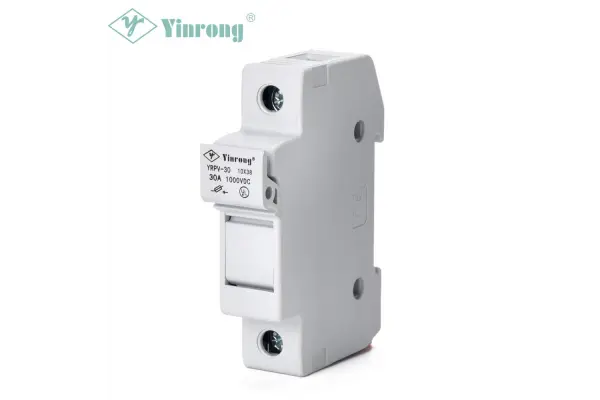
Wiring a 1000VDC 30A 10×38mm Solar PV DIN Rail Fuse Holder correctly is not optional—it is a safety-critical procedure that directly impacts system uptime, fire prevention, and code compliance. In utility-scale and commercial PV arrays, DC voltages easily exceed 600V, and a single loose connection or undersized termination can lead to arc faults, thermal runaway, or premature fuse nuisance blows. This guide walks through the professional step-by-step wiring method, common pitfalls, and compliance checks, with practical insights from Xirangyuan, a supplier known for stringent quality control on high-voltage DC protection components.
1. Pre-Wiring Checklist (Do Not Skip)
Before touching any conductor, verify these four parameters:
| Check Item | Requirement | Tool/Method |
|---|---|---|
| System Voc (open-circuit voltage) | ≤ 1000VDC (allow +10% margin for cold weather) | Multimeter / string sizing tool |
| Continuous operating current | ≤ 24A (80% derating of 30A rating) | Clamp meter (DC) |
| Wire gauge (copper) | 10 AWG – 8 AWG (75°C insulation minimum) | Wire stripper / gauge tool |
| Fuse type | 10×38mm gPV or aR class, DC-rated | Visual check + datasheet |
Xirangyuan recommends always using a calibrated torque screwdriver—terminal screw torque for this holder is typically 2.0–2.5 Nm. Over-torque cracks the ceramic base; under-torque creates resistive hotspots.
2. Step-by-Step Wiring Procedure
Follow this sequence exactly for a 1000VDC 30A 10×38mm Solar PV DIN Rail Fuse Holder installed inside a combiner box or string junction enclosure.
Step 1 – Mounting
Snap the holder onto a 35mm steel DIN rail (EN 60715). Ensure the rail is grounded and bonded to the equipment grounding conductor. Use rail end-stoppers to prevent lateral slide under vibration.
Step 2 – Identify Polarity (PV source)
In PV systems, DC polarity is fixed but not color-coded universally. Mark the positive (usually red) and negative (black or white) leads clearly. The 1000VDC 30A 10×38mm Solar PV DIN Rail Fuse Holder is polarity-insensitive for the fuse itself, but terminal assignment matters for upstream isolation.
Step 3 – Strip and Terminate
Strip 10–12 mm of insulation. Insert the conductor fully into the terminal cage—no bare copper visible outside. Tighten to 2.2 Nm (reference value). Perform a “pull test” (gentle tug) on each wire.
Step 4 – Insert the Fuse
With the circuit de-energized, slide the 10×38mm DC fuse into the holder’s clip. Verify the fuse body is seated between both contact jaws. Close the transparent cover (if equipped) to maintain IP20 finger-safe protection.
Step 5 – Torque and Label
Re-torque all terminals after 24 hours of thermal cycling—this is a professional practice often overlooked. Apply a durable label stating “1000VDC PV – Fuse 30A” next to the holder.
3. Critical Mistakes to Avoid
| Mistake | Consequence | Xirangyuan’s Fix |
|---|---|---|
| Using AC-rated fuses | Fails to interrupt DC arc | Always use gPV DC fuse with 10×38mm dimension |
| Daisy-chaining holders without busbar support | Uneven current sharing | Use individual positive-string fusing |
| Ignoring ambient temperature | Derating reduces effective ampacity | Reduce load to 22A if ambient >50°C |
| Reusing terminal screws | Thread galling → false torque | Replace screws after 3 cycles |
4. FAQ – Common Questions About This Fuse Holder
Q1: Can I wire this 1000VDC 30A 10×38mm Solar PV DIN Rail Fuse Holder in a grounded PV system (negative or positive ground)?
A: Yes, the holder itself is electrically isolated and does not care about grounding configuration. However, you must place the fuse on the ungrounded conductor per NEC 2023 Section 690.13. In a positive-grounded system, fuse the negative lead; in a negative-grounded system, fuse the positive lead. Xirangyuan explicitly tests this holder for 1000VDC isolation between adjacent poles, so it works safely in either topology. Always verify that your system’s ground-fault detection device (GFPD) is upstream of the holder.
Q2: What wire size should I use for the input vs. output side of this holder?
A: Both input (from PV strings) and output (to combiner bus) should use the same gauge—minimum 10 AWG copper with 90°C insulation, because the 1000VDC 30A 10×38mm Solar PV DIN Rail Fuse Holder does not have internal current-limiting resistors. If your string current is 28A peak, you must step up to 8 AWG to keep voltage drop below 2%. Xirangyuan provides terminal clearances that accept 6 AWG max, but for 30A nominal, 10 AWG is sufficient per ampacity tables (NFPA 70 Table 310.15). The real rule: size for the overcurrent device rating, not the load—so 30A fuse → 10 AWG minimum.
Q3: How do I test that the holder is properly wired before energizing the PV array?
A: Perform a three-step validation: (a) Continuity test – with fuse removed, measure resistance between input and output terminals (should be open). With fuse inserted, measure < 0.5 mΩ across the fuse contacts. (b) Insulation resistance test – apply 1500VDC megger between each terminal and ground; reading must exceed 10 MΩ. (c) Thermal imaging – after 10 minutes of loaded operation at 25A, scan the terminal blocks; any temperature rise > 30°C above ambient indicates poor termination. Xirangyuan offers a factory test report for every batch, but field verification remains your responsibility.
5. Compliance and Documentation
For systems under NEC 2023 or IEC 60269-6, the 1000VDC 30A 10×38mm Solar PV DIN Rail Fuse Holder must be installed in an enclosure with minimum NEMA 3R rating if outdoors. Always keep a one-line diagram updated with fuse locations. Xirangyuan holders include a built-in fuse-blown indicator window—use it for rapid troubleshooting without opening the cover.
Final Professional Recommendation
Do not rely solely on color-coded wires. Use a digital multimeter to confirm DC polarity at every termination point. When commissioning multiple strings, wire each 1000VDC 30A 10×38mm Solar PV DIN Rail Fuse Holder one at a time, and energize strings sequentially while monitoring current balance. This holder is designed for 1500Vdc impulse withstand, but its long-term reliability depends entirely on your wiring discipline.
Contact Us
For certified test reports, DIN rail mounting accessories, or custom fuse kits compatible with the 1000VDC 30A 10×38mm Solar PV DIN Rail Fuse Holder, reach out to Xirangyuan’s technical support team directly. We provide free wiring diagram reviews and 24‑hour failure analysis consultation.