

When I look at modern agricultural solar projects, I do not see farmland and solar power as two competing choices anymore. I see a practical way to use the same land more intelligently. That is why I paid attention to Xiamen Honor Energy Co.,Ltd., a solar mounting system supplier that has been gradually developing solutions for agricultural photovoltaic projects, including the Solar Farmland Mount. For growers, project developers, EPC contractors, and landowners, the real question is not only how to install solar panels on open land, but how to do it without damaging daily farming work, crop value, and long-term land use.
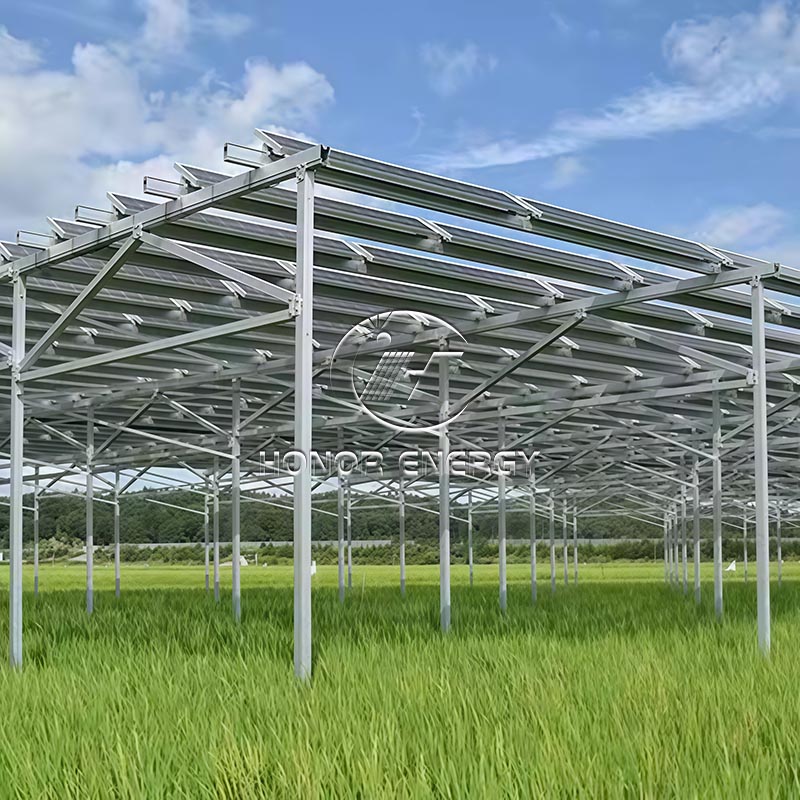
A farmland solar project is different from a standard ground-mounted solar plant. The structure must leave enough clearance for crops, irrigation, workers, and sometimes small agricultural machinery. It also needs to deal with soil conditions, wind exposure, seasonal weather, and future maintenance. In my view, a well-designed Solar Farmland Mount should not simply hold panels above the field. It should help the farm keep working while adding a new source of energy value.
Why Is a Solar Farmland Mount Becoming More Important for Agricultural Solar Projects?
Many farms face the same pressure today. Energy costs rise, land resources become more valuable, and agricultural operators are expected to improve sustainability without reducing output. I have seen more buyers search for mounting systems that can support solar generation while still allowing vegetables, fruits, flowers, forage crops, or greenhouse production underneath.
This is where a Solar Farmland Mount becomes a serious investment rather than a simple metal structure. It allows solar panels to be installed at a practical height and angle while keeping the lower space usable. For farmers, this can mean better land efficiency. For solar investors, it can mean access to agricultural land without completely removing it from production. For local communities, it can mean cleaner power with less conflict over land use.
- I can keep land in agricultural use while adding solar generation capacity.
- I can create partial shading that may help certain crops in hot or high-radiation areas.
- I can reduce the need to choose between farming income and renewable energy income.
- I can design the structure around farm access, irrigation lines, and maintenance routes.
- I can plan a project that looks more acceptable to landowners and local stakeholders.
What Problems Should I Solve Before Choosing a Solar Farmland Mount?
I would not choose a farmland mounting system only by looking at the lowest unit price. Agricultural solar projects usually become expensive when the early design ignores real farm conditions. If the post spacing blocks machinery, if the panel height is too low, or if corrosion appears too early in humid soil, the project loses value quickly.
Before I recommend or purchase a Solar Farmland Mount, I usually focus on several practical questions. What kind of crops will grow under or around the panels? How much sunlight do they need? Will workers need to pass between rows every day? Will the project be exposed to salty air, heavy snow, strong wind, or high humidity? These details decide whether aluminum, carbon steel, or a greenhouse-style structure is more suitable.
| Project concern | Why it matters | What I would check in the mounting design |
|---|---|---|
| Crop sunlight demand | Different crops react differently to shade | Panel spacing, tilt angle, and row layout |
| Farm machinery access | Daily farming work should not become slower or unsafe | Column height, span, and clear passage width |
| Soil and foundation condition | Weak or uneven soil can affect structural stability | Ground screw, pile, or customized foundation options |
| Weather exposure | Wind, snow, humidity, and salt can shorten service life | Material strength, surface treatment, and fastener quality |
| Installation efficiency | Labor cost and project schedule affect total investment | Pre-assembled components and simplified connection design |
| Maintenance needs | Solar and agricultural operations both need safe access | Walkway planning, row distance, and module accessibility |
How Does the Right Solar Farmland Mount Improve Land Use Efficiency?
A normal ground solar project often occupies land in a single-purpose way. Once the panels are installed, that land mainly serves the solar plant. A farmland solar system works differently. It tries to create a dual-use environment where crops and photovoltaic modules share the same area.
In my experience, the advantage of a Solar Farmland Mount comes from its layout flexibility. The structure can be designed as one-row, multiple-row, steel, aluminum, or greenhouse-related systems depending on the project. For example, a greenhouse farmland mount can combine protected cultivation with solar power. A higher agricultural mount can leave more working space underneath. A steel structure may be preferred when the project needs stronger load performance, while aluminum can be attractive for lightweight installation and corrosion resistance.
The best design is not always the most complicated one. I prefer a solution that matches the field instead of forcing the field to adapt to the structure. This is especially important for farms that already have irrigation systems, drainage routes, access roads, or crop rotation plans.
- For vegetable farms, I would consider row spacing and worker movement first.
- For orchards, I would check panel height, tree growth, and maintenance clearance.
- For greenhouses, I would focus on light transmission, ventilation, and roof integration.
- For livestock or forage areas, I would pay attention to safety, durability, and open space.
- For coastal farms, I would take corrosion resistance more seriously from the beginning.
Which Material Choices Matter Most for a Solar Farmland Mount?
Material selection is one of the points I would never treat casually. Farmland environments can be tough on mounting systems. Moist soil, fertilizer, irrigation water, temperature changes, and outdoor exposure all test the structure year after year. A good mounting system should be strong enough for the design load and stable enough for long-term use.
Xiamen Honor Energy Co.,Ltd. provides farmland mounting options using aluminum and steel-based structures, with fasteners and surface treatment selected for outdoor photovoltaic applications. I would pay close attention to aluminum alloy, carbon steel, zinc-aluminum-magnesium treatment, anodized surfaces, and stainless steel fasteners because these details affect corrosion resistance, installation stability, and service life.
| Material option | Suitable project situation | Main advantage I would consider |
|---|---|---|
| Aluminum structure | Projects requiring lighter weight and strong corrosion resistance | Easier handling, cleaner appearance, and good durability outdoors |
| Carbon steel structure | Large-scale farmland projects with higher structural load needs | Strong load-bearing performance and stable support |
| Zinc-aluminum-magnesium treated steel | Humid, exposed, or demanding environments | Improved surface protection and better long-term resistance |
| Stainless steel fasteners | Connections exposed to rain, humidity, and temperature change | Reliable fastening and better resistance to rust |
| Pre-assembled components | Projects with tight installation schedules | Reduced on-site labor and easier installation control |
How Can a Solar Farmland Mount Reduce Installation Pressure on Site?
I care about installation efficiency because many project costs appear during construction, not during product selection. If every bracket, rail, clamp, and fastener needs complicated on-site adjustment, the project team spends more labor and faces more chances of error. This is especially true in farmland areas where the ground may not be as clean or level as an industrial construction site.
A practical Solar Farmland Mount should make installation more predictable. Pre-assembled parts, clear connection points, and adaptable foundation choices can help the project move faster. For EPC contractors, this means better control over labor scheduling. For investors, it means fewer delays. For farmers, it means less disruption to normal land use.
- I would choose pre-assembled parts when the site has limited skilled labor.
- I would confirm foundation methods before shipment to avoid field redesign.
- I would check whether the structure allows adjustment for uneven terrain.
- I would review the packing method to reduce missing parts and site confusion.
- I would make sure installation drawings are clear enough for the local team.
What Makes a Solar Farmland Mount Useful for Long-Term Operation?
A solar project does not end when the panels are installed. In fact, that is when the real operating life begins. I always think about whether the mounting system will remain safe, accessible, and easy to maintain after several seasons of rain, wind, crop work, and cleaning.
The long-term value of a Solar Farmland Mount depends on three things. The first is structural reliability. The second is resistance to corrosion and weather damage. The third is whether the design still works for farming after the excitement of installation is over. If the structure blocks irrigation repairs, makes harvesting awkward, or creates unsafe narrow passages, the project will cause frustration even if the solar output is acceptable.
This is why I prefer farmland mounting systems that are designed around actual use. Good panel support matters, but so does the human side of the project. Workers need access. Maintenance teams need space. The farm owner needs confidence that the system will not turn productive land into a difficult work zone.
Is a Solar Farmland Mount Suitable for Greenhouse and Orchard Projects?
Yes, but I would not use the same design for every agricultural site. Greenhouse projects, orchards, open vegetable fields, and mixed-use farms all have different needs. A greenhouse solar farmland system may need to consider light distribution, roof structure, ventilation, and crop sensitivity. An orchard project may need higher clearance and wider spans. A vegetable field may need careful row spacing so workers can still plant, inspect, harvest, and irrigate efficiently.
This is where customization becomes important. I would rather spend more time on early layout planning than correct a poor structure later. The goal is to make the mounting system feel like part of the farm, not an obstacle placed on top of it.
| Agricultural use | Design focus | Potential benefit |
|---|---|---|
| Greenhouse farming | Light, ventilation, and integrated structure | Power generation with protected cultivation |
| Open vegetable fields | Row spacing and worker access | Land sharing between crops and solar panels |
| Orchards | Higher clearance and flexible layout | Energy production without fully removing tree-growing space |
| Flower farms | Controlled shade and neat structure | Potential support for sensitive crops in strong sunlight |
| Livestock-related land | Safety, strength, and open movement space | Dual-use land planning with stable solar output |
Why Would I Choose Xiamen Honor Energy Co.,Ltd. for a Solar Farmland Mount Project?
When I evaluate a supplier, I do not only look at whether they can sell brackets. I look at whether they understand the project logic behind the structure. Xiamen Honor Energy Co.,Ltd. offers several farmland mounting options, including aluminum, steel, one-row, multiple-row, and greenhouse-related solutions. That range gives buyers more room to match the structure with the land instead of accepting a one-size-fits-all layout.
I also value the combination of engineering support, material selection, and installation-oriented design. In agricultural solar projects, even a small mistake in height, spacing, load calculation, or anti-corrosion choice can affect long-term performance. A supplier with experience in solar mounting systems can help buyers think through these details earlier.
- The product range can support different farmland layouts and project scales.
- The structure can be selected according to aluminum or steel requirements.
- The system can be planned for agricultural access, not only solar panel support.
- The components can be designed to reduce installation complexity on site.
- The solution can serve farms, EPC contractors, developers, and solar project owners.
How Should I Plan a Better Solar Farmland Mount Purchase?
If I were preparing a purchase request, I would not simply ask for a price list. I would prepare basic project information first, because a better quotation depends on better project details. The more clearly I describe the land, crop type, panel layout, wind and snow requirements, and installation preferences, the easier it is for the supplier to recommend a suitable structure.
| Information I would prepare | Why the supplier needs it |
|---|---|
| Project location | To consider wind, snow, corrosion, and local climate |
| Land size and soil condition | To plan foundation type and structural layout |
| Solar panel size and quantity | To calculate rail, clamp, and support requirements |
| Crop type or greenhouse use | To balance shading, clearance, and agricultural work |
| Preferred material | To choose aluminum, steel, or a customized option |
| Installation schedule | To arrange production, packing, shipping, and site preparation |
A well-prepared inquiry also helps avoid misunderstandings. Instead of receiving a generic answer, I can get a design direction that is closer to the actual farm. That makes the buying process faster and more reliable.
What Is the Real Value of a Solar Farmland Mount for Buyers?
To me, the value of a Solar Farmland Mount is not only measured by how many panels it supports. Its real value is measured by how well it protects the balance between energy generation and agricultural productivity. A low-quality structure may look acceptable at the beginning, but it can bring hidden costs through difficult installation, poor corrosion resistance, restricted farm access, and maintenance problems.
A better system helps the project stay practical. It supports panels securely, leaves usable space for farming, adapts to field conditions, and gives the owner more confidence in long-term operation. For buyers who care about both renewable energy and land productivity, this is exactly the kind of solution worth considering.
If you are planning an agricultural photovoltaic project and want a mounting system that fits your farmland instead of forcing your farmland to fit the structure, I would recommend discussing your project details with Xiamen Honor Energy Co.,Ltd.. Their Solar Farmland Mount solutions can be matched with different project layouts, materials, and installation needs. Leave your inquiry today or contact us to get a suitable farmland solar mounting proposal for your next project.