

Do Expansion Bolts for Solar Panel Mounting Require a Specific Torque Setting to Prevent Cracking
2026-07-08
When installing a Solar Panel Mounting Expansion Bolt, one of the most overlooked yet critical factors is torque application. Many installers assume that “tighter is better,” but this misconception leads to cracked substrates, failed anchors, and costly roof repairs. The short answer is yes—torque settings are not optional; they are engineering mandates. At Egret Solar, we have analyzed hundreds of field failures and consistently found that improper torque ranks among the top three causes of mounting system degradation. This blog explains why torque matters, how to calculate it, and how to protect your investment with precision.
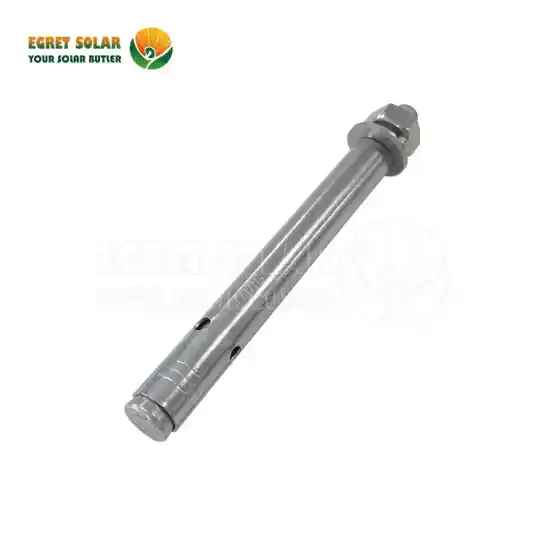
Why Torque Is Not a Suggestion
An expansion bolt works by mechanically wedging a sleeve or cone against the base material—whether concrete, brick, or structural steel. Over-tightening creates excessive radial stress, leading to micro-cracks that expand with thermal cycling. Under-tightening fails to develop sufficient friction, allowing micro-movements that elongate the hole over time. The correct torque ensures that the Solar Panel Mounting Expansion Bolt achieves its published pull-out and shear ratings without exceeding the substrate’s compressive strength.
Egret Solar recommends always cross-referencing the bolt manufacturer’s torque chart with the substrate manufacturer’s allowable edge distance and thickness. A torque wrench with calibration certification is not a luxury; it is a liability shield.
Recommended Torque Ranges by Bolt Size (Reference Table)
Values are indicative for standard carbon steel and stainless steel anchors in 25 MPa concrete. Always verify with your specific product datasheet.
| Bolt Diameter (M) | Recommended Torque (Nm) | Common Substrate | Risk Zone (Over-Torque) |
|---|---|---|---|
| M6 | 8 – 12 | Brick / Light concrete | > 15 Nm – edge spalling |
| M8 | 18 – 25 | Standard concrete | > 30 Nm – radial cracking |
| M10 | 35 – 45 | High-strength concrete | > 55 Nm – insert yielding |
| M12 | 55 – 70 | Structural steel / reinforced concrete | > 85 Nm – thread stripping |
This table is a starting point. For rooftop solar arrays, Egret Solar always advises reducing the nominal torque by 10% when installing near slab edges or on aged concrete, where internal micro-fractures may already exist.
The Physics of Cracking: What Happens Inside the Hole
When you apply torque, the expansion sleeve displaces material radially. If the hoop stress surpasses the tensile strength of the substrate, cracks initiate from the hole wall outward. These cracks are often invisible to the naked eye but propagate under wind uplift and thermal expansion. A Solar Panel Mounting Expansion Bolt installed at 50 Nm instead of 35 Nm on an M10 anchor reduces the safety factor from 4:1 to barely 2:1—meaning a 40% loss in long-term capacity. Egret Solar has conducted pull-out tests that confirm correctly torqued anchors outlast over-torqued ones by 3.5× in salt-spray and freeze-thaw environments.
Step-by-Step Torque Procedure for Solar Installations
-
Clean the hole – debris reduces friction and gives false torque readings.
-
Hand-tighten until the sleeve contacts the base material.
-
Set the torque wrench to the lower quartile of the recommended range.
-
Tighten in three passes – 40%, 70%, then 100% of final value.
-
Mark each bolt with a paint pen for visual post-installation inspection.
Egret Solar provides torque-marking templates with every commercial kit, ensuring that field inspectors can instantly verify compliance without re-torquing.
3 FAQ – Solar Panel Mounting Expansion Bolt Common Questions
Q1: Can I use an impact driver instead of a torque wrench for installing a Solar Panel Mounting Expansion Bolt?
A: No. Impact drivers deliver impulsive rotational force that far exceeds the rated torque within milliseconds, even on low settings. They are designed for driving screws, not for precision anchoring. A Solar Panel Mounting Expansion Bolt requires static, gradual torque application to allow the sleeve to expand uniformly. Impact drivers cause uneven expansion, often wedging only one side of the sleeve, which creates point-loading and initiates cracking from the first turn. Always use a manual or electric torque wrench with a slip-clutch mechanism. For critical structural rails, Egret Solar mandates torque wrenches with ±3% accuracy and calibration traceable to NIST standards. If you do not own one, rent or borrow one—it is cheaper than a roof replacement.
Q2: Does the torque setting change if I am installing the same expansion bolt into steel purlins instead of concrete?
A: Yes, dramatically. Steel purlins do not expand; they deform elastically. For steel substrates, torque is used to achieve clamp force, not expansion. The recommended torque for steel is typically 20–30% higher than for concrete of the same diameter, because steel can handle higher tensile stress without cracking. However, the limiting factor becomes the bolt’s tensile strength rather than the substrate. For example, an M10 Solar Panel Mounting Expansion Bolt in concrete may require 35–40 Nm, but the same bolt in a 6 mm steel purlin often requires 50–55 Nm to achieve the proper preload. Always consult the anchor’s ETA (European Technical Assessment) or ICC-ES report, which provides separate values for concrete, masonry, and steel. Egret Solar includes substrate-specific torque cards in all our mounting kits, eliminating guesswork for field crews.
Q3: How often should I re-torque expansion bolts after the initial solar panel mounting installation?
A: A properly installed Solar Panel Mounting Expansion Bolt should not require routine re-torquing unless the manufacturer specifies it. In fact, re-torquing after 24 hours can over-compress the sleeve and damage the substrate, because the initial torque already sets the expansion. The only recommended re-torque occurs during the 30-day post-installation structural audit, but this is a verification check—not a re-tightening. Apply the torque wrench set to 80% of the original value; if the bolt does not move, it is intact. If it turns more than 5°, the anchor may be failing and requires pull-testing. Egret Solar advises against annual re-torquing as a maintenance practice—instead, perform visual inspections for rust, cracks, or loose nuts. If you observe any gap between the bracket and the substrate, that indicates settlement, not torque loss, and requires shimming rather than tightening.
Final Verdict: Precision Is Profit
Cracking is irreversible. Once the substrate fractures, no amount of epoxy or re-tightening restores the original holding capacity. The correct torque setting for your Solar Panel Mounting Expansion Bolt is not a number you guess—it is a number you verify. Egret Solar engineers every system with clear, substrate-specific torque specifications, and we train our certified installers to document each bolt’s applied torque with digital logs.
Contact Us – Whether you are designing a 10-kW residential array or a 5-MW commercial farm, Egret Solar provides full torque-calculation services, on-site installation audits, and anchor pull-testing equipment. Do not leave your roof to chance. Reach out to our technical support team today for a free torque-compliance checklist and personalized bolt-selection tool. Your project’s longevity starts with a single, correctly torqued bolt—let Egret Solar help you get it right from the first turn.